Breaking the ICE: A Letter from the Frontline
:Report from an Anti-ICE March in Philadelphia


In the following report-back, participants in a march against Immigration and Customs Enforcement in Philadelphia reflect on how to move from symbolic protests and top-down organizational models to effective autonomous action. As the conflict between federal mercenaries and the people of the Twin Cities intensifies, others around the country are looking for concrete ways to act in solidarity in order to divide the attention and resources of federal forces. We encourage everyone who participates in demonstrations to show up in affinity groups with concrete plans as to what they hope to accomplish and bold proposals to share with others.
The more agency and initiative each of us brings to our collective activity, the more powerful our movements will be.
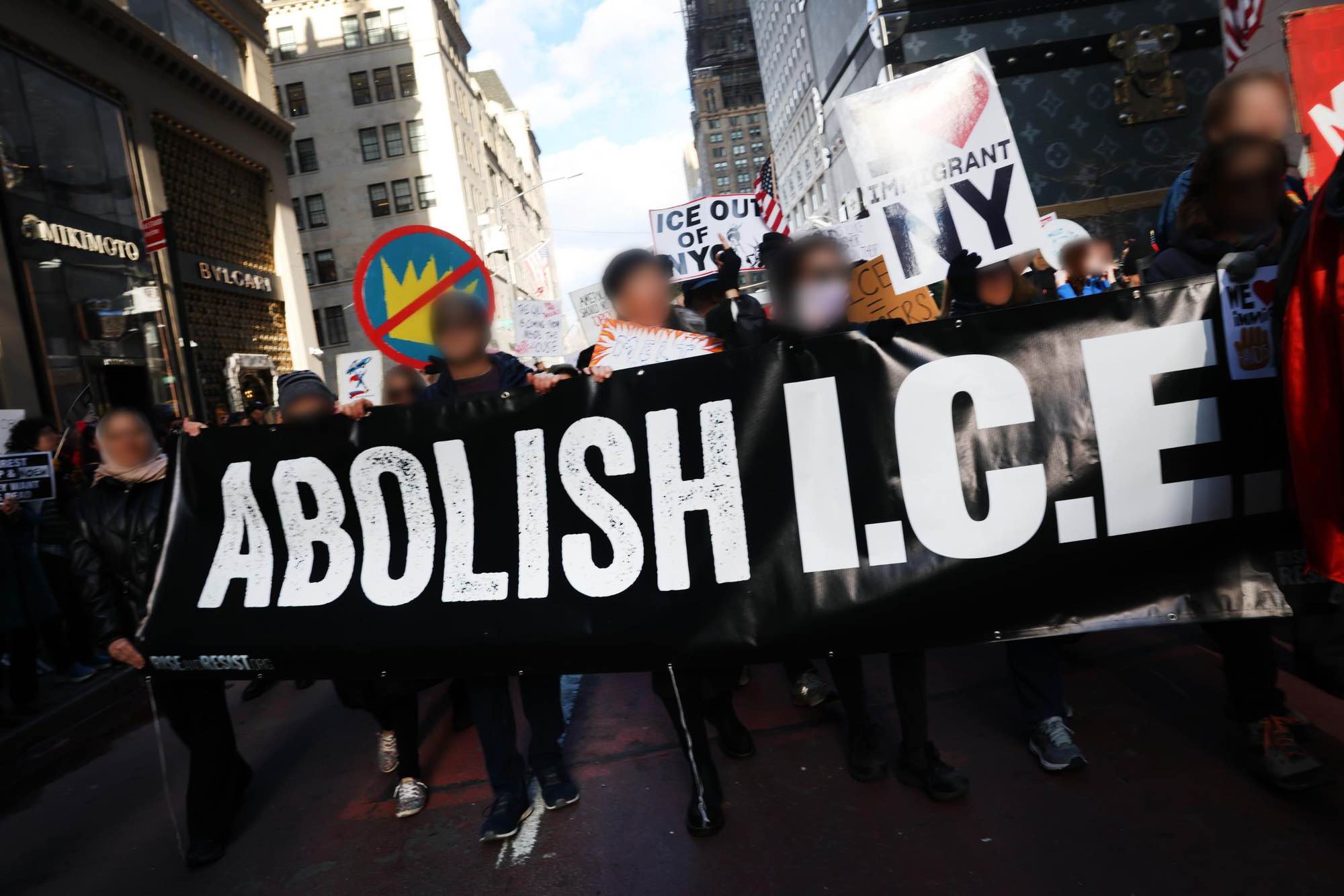
On the night of January 23, the day of the general strike in the Twin Cities, a rowdy march against ICE took place in downtown Philadelphia, involving about 300 people. At the conclusion of the march, a couple dozen militants decided to break off and head in the direction of the nearby ICE office. The march organizers—Socialist Alternative—had told the entire crowd at the beginning of the march that they planned to circle City Hall once and then march together to the ICE building.
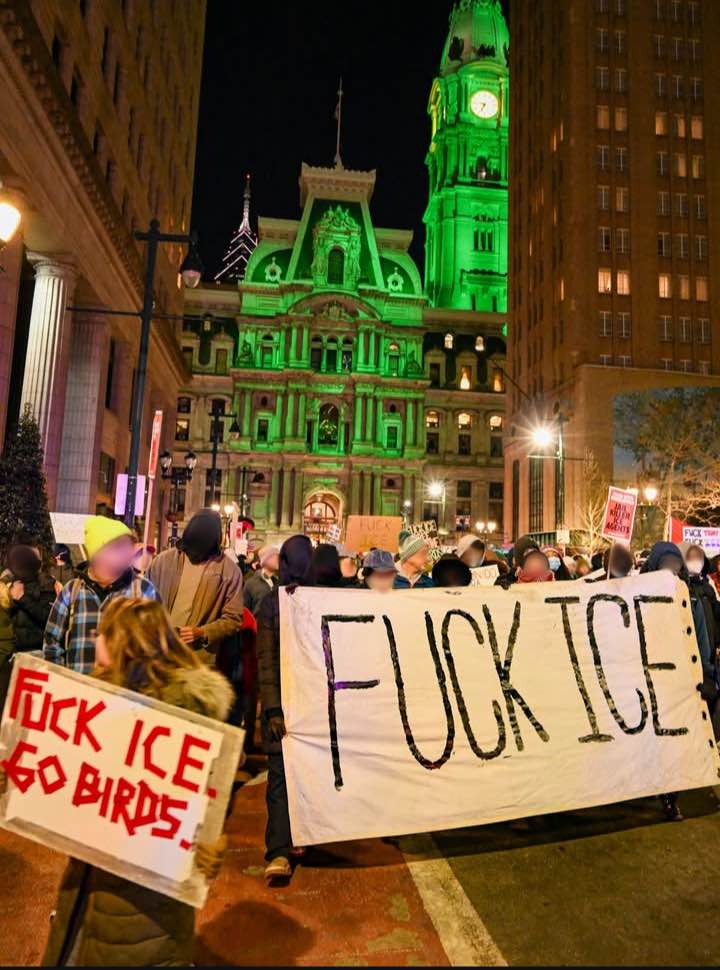
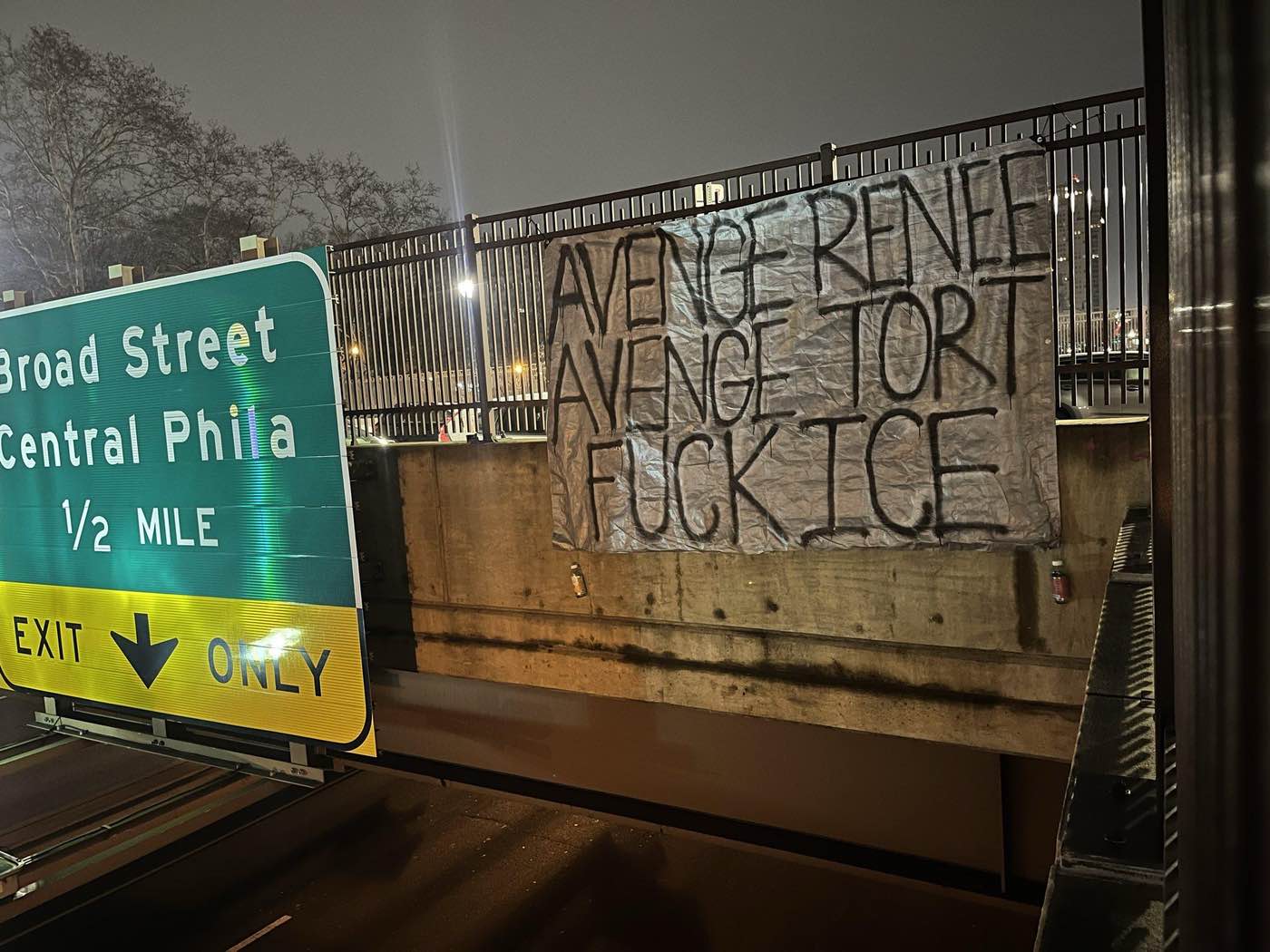
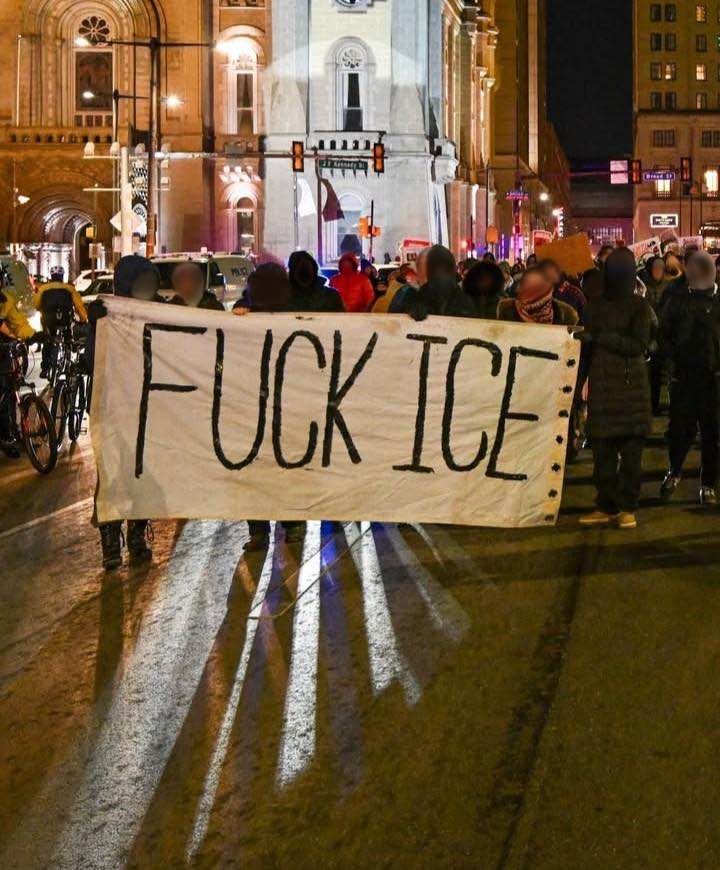
We had heard about the march just the day before. A small group of us quickly prepared a banner reading “FUCK ICE.” During the march, we carved out a spot for ourselves at the front, despite commands from self-appointed protest marshals to “move to the side” and make more space for their party-branded content.
The march proceeded down a major thoroughfare of the city, the simple “Fuck ICE” banner attracting enthusiastic support from onlookers. Then, strangely, when the crowd was just one block away from the ICE headquarters, the marshals directed everyone to the Federal Detention Center two blocks away. There, the organizers set up a weak sound system and began making speeches to the confused crowd.
At the same time, a member of a competing state socialist faction, the Revolutionary Communists of America, pulled out their own megaphone and started soapboxing to the people around them about the working class in a bid to one-up their competitors. The energy, which had been lively throughout the march, dissipated rapidly.
Someone asked one of the protest marshals why we weren’t converging on the ICE building. “There’s no shortage of targets,” they answered.
This rally was explicitly organized in solidarity with the general strike in Minneapolis, which itself was a response to the invasion of the city by ICE and the recent murder of Renee Nicole Good. On January 24, the day following the general strike, ICE agents murdered another person in Minneapolis, Alex Pretti.
The usual alphabet soup of state socialists were there. Aside from Socialist Alternative (the main organizers), there were also the Revolutionary Communists of America, the Party for Socialism and Liberation, and others, each faction vying for their spot in the limelight with recruitment tables, proselytizing overtures, and promotional literature. They made many speeches about how we need to go beyond symbolic protest and take the next step into direct action against ICE.
But when protesters broke away to engage the nearby ICE office, most of the crowd simply looked on or away. Some jeered, made snide comments, or expressed disdain. Nonetheless, a few were curious or supportive. It is worth noting that, in a march that was probably 95% white, many of those who joined the breakaway march were not white, and specifically young and Black.
As we marched towards the throng of police outside the ICE office, encouraged by one enthusiastic snare drummer’s beats, some in the crowd began to chant “Migra, policia, la misma porqueria!” Someone made some quick remarks about how the Philadelphia Parking Authority and the Philadelphia police were protecting ICE. When someone in the crowd yelled “Fuck 12” in response, we all began chanting “Fuck ICE! Fuck 12!”
It was clear that there were too many police and too few people in the crowd to breach the office, which had been barricaded in anticipation with metal crowd barriers. So after a short while, the group took their exit, flipping off the bike cops.
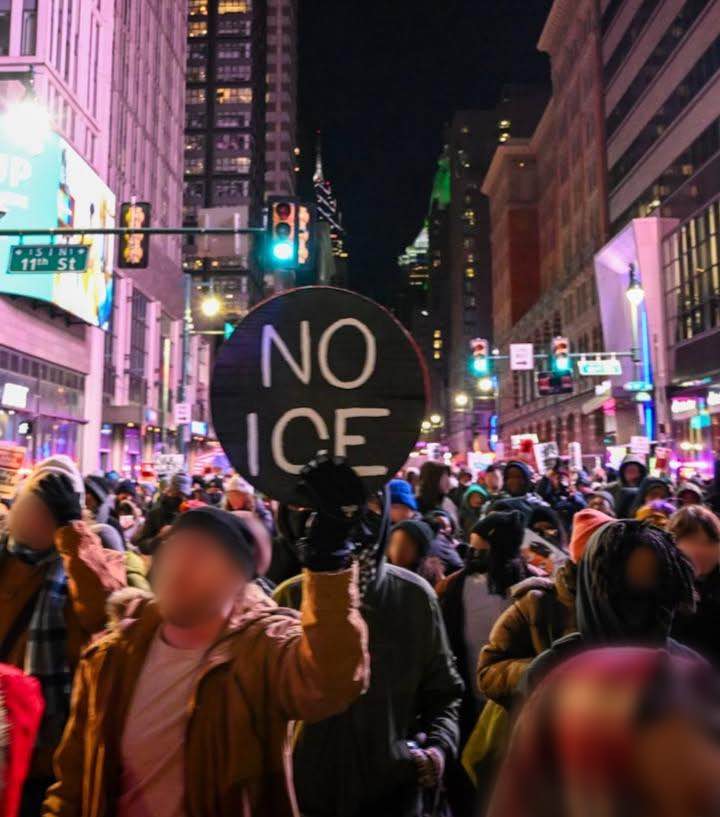
If nothing else, some of those who were confused about the location of the ICE headquarters now know exactly where it is. Experimenting with the breakaway march as a protest tactic was also a useful exercise in that it demonstrated what a small number of frontliners can do as part of a larger crowd, showing the potential of autonomous direct action within a broader ecology of tactics.
Not all of the state socialists took a paternalistic attitude toward the militants who engaged the ICE headquarters. One of the protest marshals joined us at the end and made a genuine effort to show support and have our backs as we approached the building and the police stationed outside of it. The problem is not the intentions of specific individuals, but rather that the organizational structures of these groups are not oriented towards practical direct action. They remain stuck in the mire of representational, spectacle-based politics.
The class struggle, which necessarily involves a dynamic ecology of different kinds of action, is not the driving motor of organizational development and innovation for these groups. Instead, they filter class struggle through the sieve of each group’s particular brand of state-directed revolution, which the movement managers and wanna-be politicians of each respective faction are trying to sell us. When organizational fetishism is the driving force of a struggle, revolutionists appear as nothing but snake-oil sellers.
As a consequence, the burning need for decisive action is put off indefinitely. Rather than presenting opportunities to disrupt the operation of ruling class infrastructure, militant demonstrations instead become opportunities for selling newspapers, photo-ops, recruitment drives, and ideological competition between various bullhorn-wielding aspiring leaders.
It was heartening to see the federal inmates waving at us and flickering their lights from the inside. It was good to pay them a visit. But there is something very wrong with a march against ICE in which protest marshals direct the crowd away from a building ICE uses as its headquarters. At a certain point, revolutionaries need to make a choice: are you organizing for revolution, or building a political clique?
For those who want to make a revolution against class society, the spectacle of symbolic protest and organizational fetishism is a dead end. The 2020 George Floyd uprising, the Eddie Irizarry rebellion in 2023, and the anti-ICE rebellion in Los Angeles last year show us that there is another way: the path of militant solidarity, mutual aid, and autonomous self-activity and self-organization. The revolt against ICE that is unfolding in Minneapolis is currently the most advanced iteration of this mass historical dynamic within the United States. Rather than looking to the fantasies of the past, we should take our cue from the frontline in Minneapolis and follow their example. We have to fight with strategy, organization, and vision—but nonetheless, we have to make the leap.
Now is the time to get together with those you trust, to call more demonstrations, to organize rapid response networks with your neighbors, to facilitate assemblies, devise plans, experiment with bold tactics, take the initiative, build momentum, stretch the limits of whats possible, and most importantly, embrace every strategy at our disposal for tearing this motherfucker down and building a new, better world, including direct intervention against ICE and all agents of state repression.
See you in the streets!
– Your autonomous comrades across the partisan divide